
At Saint-Gobain, we strive to build a more sustainable and inclusive world. Therefore, to establish our sustainability approach, we have set objectives to reach by 2030 in our key focus areas:
- In 2019, we committed to achieving net-zero carbon emissions by 2050 by signing the UN Global Compact's "Business Ambition for 1.5°C" pledge. Our CO2 roadmap for 2030 includes a 33% reduction in scope 1 and 2 emissions and a 16% reduction in scope 3 emissions compared to 2017 levels. These targets have been validated by the Science-Based Targets initiative as being in alignment with our 2050 goal. Looking further ahead, we now aim to reduce scope 1 and 2 emissions by 40–45% by 2035, reinforcing our commitment to climate action.
- Advancing a circular economy model by decreasing non-valorised production residue by 80%, increasing the avoidance of virgin raw materials by 30%, and using 100% recyclable packaging with at least 30% recycled or bio-sourced content
- Conducting life-cycle assessments for all our product ranges
- Decreasing industrial water withdrawal by 50% and eliminating water discharge in areas with a high risk of water scarcity
In everything we do, we are guided by our engaging purpose: Making the world a better home. Our mission is to facilitate the shift towards sustainable construction by offering glass solutions that prioritize both sustainability and performance. This means that we strive to deliver innovation, design and cost-efficiency through better buildings, reduced environmental impacts and improved indoor conditions for the health and well-being of occupants. We understand that sustainable construction is not just about the process but also how the building will be used. For this purpose, we provide our customers with innovative solutions that support their journey towards sustainability, and we advocate for better policies, standards, and practices within the construction market.
SAINT-GOBAIN APPROACH FOR SUSTAINABLE CONSTRUCTION
For us, over their whole life cycle, buildings should enhance people’s health & wellbeing while having reduced footprint on the planet. They should offer better economic value and quality for the developers, owners and occupants.
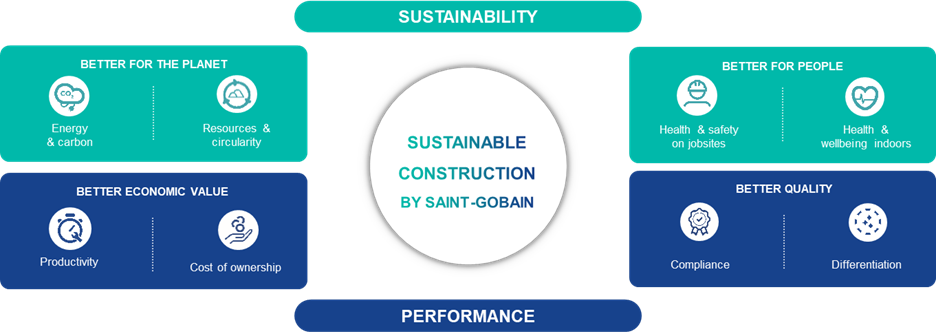
When designing a new building or renovating an existing one, it is important to balance the environmental footprint with the benefits for people. At Saint-Gobain, we believe that buildings should address carbon emissions and promote circularity. Reducing carbon emissions and dependence on non-renewable resources is crucial for a sustainable future. Our goal is to apply a holistic vision of construction throughout a building’s lifecycle, promoting sustainable practices and reducing environmental footprint while ensuring the well-being of both workers on job sites and occupants.
BETTER FOR THE PLANET
ENERGY AND CARBON
Cities around the world account for over 70%¹ of energy consumption and related greenhouse gas emissions. Building operations alone account for about 34%² of energy consumption and 37%² of energy-related CO2 emissions in 2021. Various environmental impacts occur throughout a building's life cycle: from the extraction of raw materials to construction to the operating stage, and then demolition. Reducing energy use and achieving zero greenhouse gas emissions in the built environment is crucial.
¹ OECD: Cities and Environment
² Global alliance for buildings and construction: 2022 global status report for buildings and construction
RESOURCES AND CIRCULARITY
The construction sector plays a key role in shaping the availability of natural resources. Globally, construction accounts for about 40%¹ of raw materials consumption, consequently generating 40%¹ of solid waste streams. Most of this occurs during the construction and renovation/demolition phases and causes significant environmental impacts.
In this context, the need to mitigate such impacts is essential, for the construction industry to move from the current model to a more sustainable one, with an emphasis on adopting circular economy approaches.
¹ Global Alliance for Buildings and Construction, Global Status Reports 2017
BETTER FOR PEOPLE
HEALTH AND WELL-BEING INDOORS
Indoor living conditions significantly influence the health and well-being of a building’s occupants. Given that we spend over 90%¹ of our time indoors, it’s crucial to create favorable indoor environments that extend beyond basic needs, ensuring comfort regardless of the climate. Taking a holistic approach involves balancing various parameters to maximize occupants’ well-being. Addressing fundamental needs is essential to prevent sick building syndrome, which can lead to poor health conditions.
¹ World Health Organization: Combined or Multiple Exposure to Health Stressors in Indoor Built Environments (2014).
HEALTH & SAFETY ON JOB SITES
According to the International Labour Organization (ILO), 1 billion builders¹ all over the world are exposed yearly to hazardous substances during their working hours, including fumes, dust, pollutants, and vapours. Construction workers face risks due to their working conditions, including working at heights, handling heavy materials or equipment using mobile devices, and being in close proximity to hazardous substances like asbestos or silica. To safeguard workers’ health, safety, and well-being, it is imperative to make every effort to protect them on job sites.
¹ Exposure to hazardous chemicals at work and resulting health impacts: A global review
BETTER PERFORMANCE
Improving the performance of buildings is also about ensuring that the materials and solutions used are of the highest quality, providing a guarantee that the building will last for many years. Additionally, it is important that there are various options available in terms of looks, in order to adapt the construction to evolving design trends.
To improve the quality of buildings, we can use solutions that have been tested and proven to have guaranteed quality, choose long-lasting materials, incorporate dedicated solutions for safety and protection, select the right colours and finishes, and develop wide architectural possibilities by providing different shapes.