

Description
"Guide to the future"
The Gillies Hall student residence at Monash University, which was completed in February 2019, is currently Australia's largest certified passive house constructed with components made from cross-laminated timber (CLT). The glasses on the building envelope were supplied by the Saint-Gobain Glassolutions insulating glass center, located in Bamberg.
Jackson Clements Burrows Architects (JCBA) are setting new standards with Gillies Hall in the Australian architecture scene: the student residence on the Peninsula campus of Monash University in the Melbourne suburb of Frankston, with its six floors and a gross floor area of 6,500 square meters, is currently that largest passive house certified building made of CLT (Cross Laminated Timber) panels in the country, even in the southern hemisphere.
The architects have already received numerous awards for their new building, including the 2019 Climate Prize of the Construction21 "Green Solutions Awards", first place at the Premiers Sustainability Awards and the sustainability award of the Australian Timber Design Awards, which was also awarded in 2019.
With Gillies Hall, the architects are meeting the university's declared goal of being net zero carbon emissions by 2030. The building has a heating requirement of 5 kWh / m²a attested; This means that it achieves a value around 70 to 80 percent lower than a comparable building constructed for Australia using the conventional construction method. According to the engineers from Grün Consulting commissioned with the passive house certification, the primary energy requirement of Gillies Hall is 131 kWh / m²a. The air exchange rate n50 is 0.5.
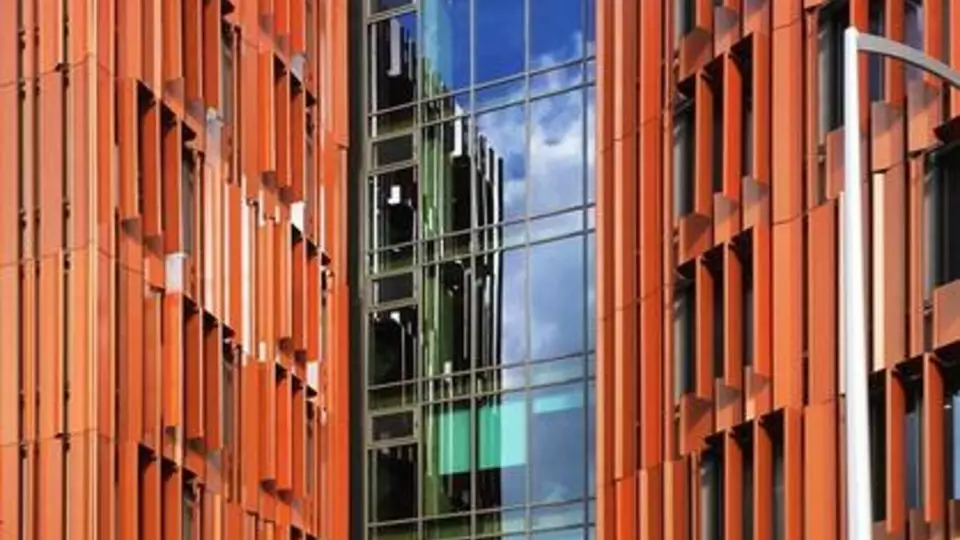
The student dormitory comprises 150 single apartments, two service apartments and generally usable areas that are available to around 250 students living on campus. The warm, light tones of the glued laminated walls and ceilings characterize the atmosphere inside the building and make Gillies Hall a cozy temporary home. The solid wood construction on a concrete base was erected in just eleven weeks. On the outside, the five upper floors have a striking cladding made of red-orange, vertical sheet metal lamellas. In front of the windows, the metal sheets are set up at 90 degrees and thus cast lively shadows on the building envelope.
Choosing the right glazing is of great importance for achieving the passive house standard. This was supplied to Gillies Hall by the Saint-Gobain Glassolutions insulating glass center, Bamberg location (SGIC). A total of 1,062 m² of insulating glass was installed in cooperation with the Australian company LAROS Technologies, RAICO Bautechnik GmbH and the SGIC customer and producer of the wood-aluminum windows Döpfner Betriebs GmbH & Co. KG from Gerolzhofen. The sun protection insulating glass COOL-LITE® XTREME 50/22 with toughened safety glass and SWISSPACER® ULTIMATE was used for the two RAICO timber construction curtain walls.
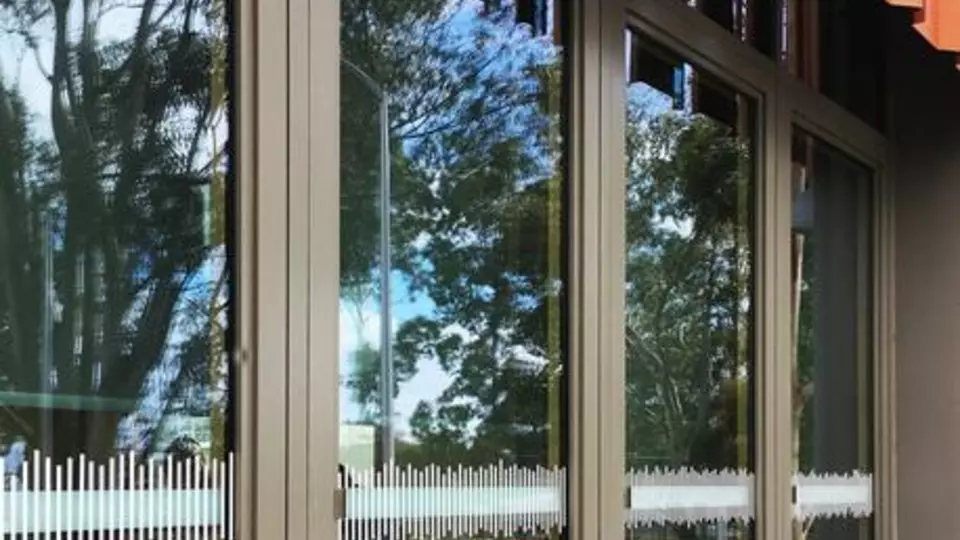
CLIMAPLUS COOL-LITE® SKN 176 with the passive house-certified warm edge spacer SWISSPACER® ULTIMATE was used for all Döpfner wood-aluminum windows and all RAICO wood construction facade elements on the ground floor, which very efficiently eliminates cold bridges at the glass edge. With a water-vapor and gas-tight film, it also ensures that the gas filling does not escape from the space between the panes and that no water vapor can penetrate it over the entire service life of the window. In this way, the insulating function of the insulating glass, and consequently of the building, is guaranteed over the long term.
The solar panels installed on the roof and the wind energy fed in from the Murra Warra Wind Farms between Adelaide and Melbourne also contribute to the passive house standard. Gillies Hall also has a rainwater tank; a corresponding concept allows the use of excess water on campus.
The namesake Max Gillies studied at Monash University in the 1960s. The well-known Australian actor and film producer rightly called the building named after him at the inauguration ceremony in August as a “guide to the future”. And Professor Margaret Gardner AO, President and Vice Chancellor of Monash University, praised the JCBA building as “the most beautiful addition to the Peninsula campus”. Gillies Hall is the first building that the university has completed based on the premises of the Net Zero Initiative.
Related products

COOL-LITE® SKN 176 & 176 II
COOL-LITE® SKN 176 and SKN 176 II sets standards in terms of aesthetics and solar control function. Both coatings, respectively the annealed and to-be-tempered version have a neutral lively reflection aesthetic.

COOL-LITE® XTREME 50/22 II
COOL-LITE® XTREME 50/22 II is a heat treatable triple silver solar control coating with an outstanding selectivity of 2.24.

PLANICLEAR®
PLANICLEAR® is our standard clear float glass in Europe, exhibiting a neutral aesthetics, answering to the numerous needs of the glass and glazing for the building market.